Robustly post-modern, post-Brexit, post-BS, Trump-era, alt-left, anti-Imperialist, anti-Neoliberalist, anti-Zionist, pro-peeps worldwide. Fierce irreverance from an Old Leftist and all the Fake News that's not fit to print.
No Zionist wankers, no alt-right and no snowflakes, please!
It's beginning to look a lot like a Victorian dystopian Christmas!
Googling for the phone number of Sycamore House (my local NHS health facility) it turned out the number on their website is wrong (as it was three weeks ago!), so their answer thingy told me to call 01578 5838 13428. A MEDICAL FACILITY, fer Chrissake!
I needed to check the hour of my appointment with Quay Gardens (a mental health facility near me, yeah, you've guessed: all this is driving me bonkers!), so I looked it up on that Google. Strange: no phone number on their contact page?!?
So I called Sycamore House and 5 menus and half a symphony later a nice lady gave me the number 0954 35757 475.
So Quay Gardens (a NHS mental health facility) are self-sabotaging their own telephone system, presumably because of Covid/Omicron/G-d only knows...
And the rot may not be limited to the public sector.
I've banked with NATWEST for over 20 years, had a mortgage, 2 business accounts and a hefty business loan with them.
Now I wanted to apply for another business account, primarily to take advantage of their advertised business account overdraft.
So email address and created PW at hand, I applied.
Funnily enough, apart from one 'verify your email address' style response I got nothing.
Now every time I visit that site it tells me I'm logged out and 'please login'. Doing so then leads to nowhere.
A Natwest Business Account application 'in progress' [COUGH...]
NATWEST doesn't accept applications anymore and fails to tell (potential and actual, like me) customers about that. Strange for a Company that informs their entire G-ddamn customer base when their CEO has parted with a small fart!
They have of course form in that department. At the time of the 1st Lockdown(TM) a businessman appeared on the Beeb. He had opened a Business Account with cards and everthang, only to find two days later they'd cancelled his account and card and not a nairy peep from NW, like a text message or somfink! That business crashed into the floor before it had learned to even glide...
And the reason for all of this? NW fearing to be inundated with bounce-back-loan requests! So much for the 'Bank of small business!'...
And oh and wait. While I went inbranch asking (vaingloriously of course) about a NW business account and as the Droid said the magic words 'apply online', she gave me a card of the 'BUSINESS TEAM AND CLUBS AND SOCIETIES' (huh?) with a number, which I'll call. If the word 'online' is muttered by anyone but me I'll SCREAM!
Note: for privacy reasons names and phone numbers have been changed (except for NW because it's in the public sphere)
My childhood friend Bert, whom I haven't seen now in more than 35 years, started developing mental health problems some 30 years ago. He struggled with depression, anxiety and psychotic episodes to boot, to date.
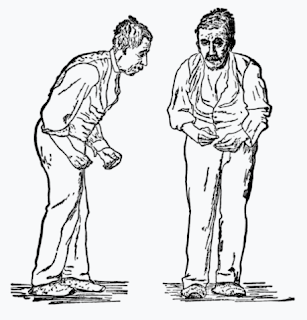
About 10 years ago, he also contracted Parkinson's Disease, which became progressively worse and worse, up to the point where he basically couldn't do anything anymore.
Recently things took another turn for the worse (is that really possible?) and he's now in hospital, since 8 weeks ago. Nothing works anymore except for his beating heart. We all 'pray' for a Merciful and speedy demise.
Bert's wife Elaina and his mother Sammy deserve more than a mere mention here, two very strong women who are doggedly and lovingly looking after Bert. Elaina also has to contend with two parents that are developing dementia...
I can only wish a speedy 'RIP, Bert' for him and his amazing family.
When I knew him for some 12 years a nicer, more soft-spoken person than Bert would have been to find but it appears they always 'get to the nice ones first'.
A few days ago, Bert finally passed away. Thanks whoever.
In Part II I'll attempt to measure the characteristic d value.
Immediately a problem becomes apparent:
In the schematic, θ is the angle of incidence and α' ('alpha prime') the angle between the purple line and the 'pseudo-crystal's' centre line (green). That blue line represents the orientation of the molecular planes (against which diffraction takes place). Without a value for α' it is impossible to determine α and β and thus d (recall the Bragg condition here.
One solution (among others) is to orient the cube so that:
and:
α = β = π/2
In that case there's no diffraction ('zero order diffraction'), only non-interactive reflection and the angle α' is bound by:
α' + θ = π/2
This however is easier said than done: at high angles of incidence the diffracted ray becomes weak (because travelling distance and thus absorption become high?) Furthermore, suspected higher order diffraction (n > 1) and/or unwanted internal refections make it hard to discern signal from noise.
To avoid this it was decided to determine the critical angle θc by means of correlation and subsequent extrapolation. 4 data points, each with a duplicate, were generated as below. The angles were determined with a small protractor (goniometer) and by simple Pythagorean trigonometry. The raw data were:
Correlation of the data:
I'm no longer a student or an 'institutionalised' scientist so don't have access to near-automated ANOVA but the data as well as intuition prompted me to believe the (slightly) quadratic model is the preferred one here, which yields:
γ = 0.04916 + 1.658 θ + 0.8458 θ2
Solved for γ = π/2 we then obtain θc:
θc = 0.681
and with:
α' = π/2 - θc = 0.8898 (51.0 deg)
This value of 51.0 deg 'feels' right and seems in accordance with some preliminary estimates (not reported here). But caution needs to be sounded, as the value is an extrapolated one, not a directly measured value.
(The meaning of γ should be clear from the diagram below:)
Determination of d:
Using the diagram for γ (above) another additional 5 data points, using the schematic below, were generated:
Measurable angles were determined by Pythagorean trigonometry and the angles α and β with some angle algebra. A total of 13 data points where thus obtained and processed (including the 8 previously obtained points):
Which gives me an average μ = 404 nm +/- 40.2 (95 % confidence)
While there's considerable spread on the results, one has to bear in mind the experiment was executed on a dining room table, with a mini protactor, some blue tack, a tape measure and two pen-type lasers.
Testing the model's predictive power:
Next week I'll test the model with 2 other lasers because:
sin β= n λ / d - sin α
Here's the result for 3 data points with the 532 nm green laser:
So the predictions for d = 404 nm aren't perfect but they're not bad either.
Here's the set up again:
The experiment specifically with the green laser also solved another mystery: where are these other diffractions that can be expected from a number of almost random micro-globule planes? Well, with the green laser, which is much more powerful (a range of a couple of kilometer) than the red and purple pen-lasers, they reveal themselves (more about that later) clearly (potentially, it the completest darkness, the red laser would also work to show the additional diffractions)
Here's the result for 3 data points with the 432 nm purple laser:
Although the predictions with the 432 nm laser are slightly less good, the trend prediction is still there.
Overall conclusions so far:
1. This synthetic Opal cube shows clear and strong Bragg diffraction for an inter-molecular plane with d = 404 nm, oriented at 51.0 deg w.r.t. the central line of symmetry of the cube.
2. Experiments with the powerful green laser (532 nm) shows multiple Bragg diffractions, corresponding to multiple intermolecular planes at various angles w.r.t. the central line of symmetry of the cube. This requires further investigation.
Diffraction is one of the most frequently encountered physical phenomena in the human world. It is responsible, among other things, for us being able to shout (and hear) ‘around’ a corner and explains why radio and television signals reach every hook, nook and cranny of a city. Diffraction is also the underlying mechanism of the iridescent colours of soap bubbles and petrol on a puddle, as well as the rainbow effect of so-called 'Newton's rings'.
Teachers the world over, together with backyard scientists, have demonstrated the occurrence of diffraction using one-slit and two-slit diffraction, diffraction about a thin wire or through a pin-point hole, using cheap lasers in the VIS (visible) part of the electromagnetic (EM) spectrum.
Here’s one of my one-slit experiments using a green pen-style laser (forgive the crappy wall paper used as background):
The laser's green light's wavelength here was 532 nm and the slit width about 30 micron (in the order of magnitude of a human hair)
The lighter areas show up where positive interference occurs, the darker ones where negative interference is found.
X-ray diffraction (XRD) – Bragg diffraction
Scientifically XRD has been used to probe the internal, atomic structure of materials like NaCl (table salt), crystalline DNA and minerals to name but a very, very few. The X-ray part of the EM stretches from wavelengths of 10 pm (‘hard’ X-rays) to 10 nm (‘soft’) X-rays). This is highly relevant because as an order of magnitude this corresponds approximately with significant length scales inside of said crystalline materials.
XRD basically works like this:
The horizontal black lines represent crystal planes (linear planar alignments of actual atoms inside the crystal under investigation). The inclined blue lines represent incident and diffracted X-rays, and α and β the angles of incidence and diffraction, respectively. It can then be shown that the formula at the bottom of the figure correctly predicts the values of α and β for which positive interference occurs. This manifests itself in a lighter area in the ‘detector’, e.g. a camera.
In the formula, aka the Bragg Condition, λ is the wavelength of the monochromatic) X-rays, d is the distance between the atomic planes in the crystal and n is an integer (1,2,3…, aka the 'order' of diffraction)
Clearly, with a suitable experimental set up, this opens up the exciting possibility of determining d (QED the case of DNA, Watson and Crick) and thus the crystalline structure of a material.
Note that in a real crystal, there are many possible sets of atomic planes where diffraction can occur, leading to complex diffraction patterns that can only be 'disentangled' by means of advanced math. Again, QED the case of DNA. Below a representation of a few planes (thick blue lines) in a 2 D cubic lattice (thin black lines, the nodes are atoms):
This type of so-called X-ray diffraction crystallography was discovered by a father and son team by the name of Bragg (in 1913)
Bragg diffraction using VIS light?
Would it be possible to apply the Bragg principle using VIS EM, using cheap pen-type lasers? In principle ‘yes’ but the Bragg condition shows such a material would have to possess “d-values” in the order of magnitude of the wavelength of the visible light which is approximately 400 to 800 nm (much larger than X-rays’ 10 pm to 10 nm range)
a. Construction of a 'pseudo-crystal' lattice using thin and transparent films:
Using various film substrates like cellophane, polypropylene/polyethylene, kitchen cling film and microscope slides, various ‘stacks’ were constructed and tested for diffraction using the red laser. While weak diffraction was obtained, it was not measurable. The thinnest film was about 50000 nm thick and most films weren’t transparent enough when stacked to about 0.5 mm thicknesses.
b. Iridescent ‘Merry Christmas’ banner:
Next up, a suggestion by ‘farcher’ at the physics.stackexchange.com/ website (of which I am a proud member): ‘Merry Christmas’ style banner film. Below a photo of a piece of film I cut off:
The material shows strong surface (reflective) VIS diffraction, which produces that very attractive shimmering colours effect. This material looks very different depending of the angle of visible light incidence.
The film is very, very thin and somewhat see through.
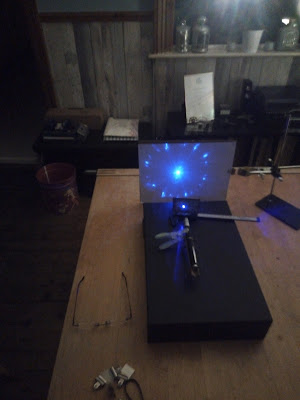
This led to the first successful VIS Bragg diffraction experiment of mine, using a purple laser of 432 nm wavelength, by shining it through the film and projecting the result onto a white paper 'detector':
The diffraction pattern, the dozen or so points arranged on a circle (approximately), are positive interference points, resulting from diffraction by internal atomic/molecular planes.
But the material is highly anisotropic and moving the incident laser a little, changes or destroys the observed pattern. This makes it unsuitable for any quantitative analysis. But we can be sure the “d values” are in the order of magnitude of 400 to 800 nm.
The diffraction here is caused by superthin 'confetti', dispersed throughout the resin matrix of the film. Varying orientations of the confetti then explains the unusual iridescence.
c. Synthetic Opal as a ’pseudo-crystal':
Here is a stock photo of a synthetic Opal cube, which I then purchased:
The iridescent colours of white (non-monochromatic) light is caused by Bragg-style diffraction (it is a truly beautiful - and cheap - object) I believe my purchase is a so-called Gilson-type synthetic Opal.
A simple experiment using the red (obviously monochromatic) laser showed very strong, consistent and clear diffraction. It’s so evident that the cube could be used as a beam splitter: much of the laser beam travels unimpeded through the 'crystal' but another part is strongly diffracted (about 45 degs) to the left:
Here is a (clearer) schematic:
It is well-documented that Opal is made up of semi-hydrated silica micro-globules, organised into planes. The structure thus mimicks real crystalline materials like NaCl but with much larger values of d, making it susceptible to diffraction with VIS EM radiation (light)
Below a micrograph of natural Opal (unfortunately no scale or reference was provided) Globules of semi-hydrated silica form sheets (planes) which provide diffraction:
In Part II I will set out to quantitatively determine the d-value.
And here's a beautiful video on the history of X-ray crystallography (H/T Farmer John: