It seems like we're living in an epidemic of false belief. Clearly the other side just doesn’t have all the facts, right? Or are they really that stupid? In this fascinating and hilarious talk, cognitive scientist Philip Fernbach peels back the layers of what we really know and reveals some surprising truths about the human mind.
Wednesday, 27 July 2022

Monday, 25 July 2022
Wednesday, 20 July 2022
The Odious Mr Churchill: Two Essays
Shashi Tharoor, Washington Post 10.3.18.
“History,” Winston Churchill said, “will be kind to me, for I intend to write it myself.” He needn’t have bothered. He was one of the great mass murderers of the 20th century, yet is the only one, unlike Hitler and Stalin, to have escaped historical odium in the West. He has been crowned with a Nobel Prize (for literature, no less), and now, an actor portraying him (Gary Oldman) has been awarded an Oscar.
As Hollywood confirms, Churchill’s reputation (as what Harold Evans has called “the British Lionheart on the ramparts of civilization”) rests almost entirely on his stirring rhetoric and his talent for a fine phrase during World War II. “We shall not flag nor fail. We shall go on to the end. … We shall fight on the beaches, we shall fight on the landing grounds, we shall fight in the fields and in the streets. … We shall never surrender.” (The revisionist British historian John Charmley dismissed this as “sublime nonsense.”)
Words, in the end, are all that Churchill admirers can point to. His actions are another matter altogether.

During World War II, Churchill declared himself in favor of “terror bombing.” He wrote that he wanted “absolutely devastating, exterminating attacks by very heavy bombers.” Horrors such as the firebombing of Dresden were the result.
In the fight for Irish independence, Churchill, in his capacity as secretary of state for war and air, was one of the few British officials in favor of bombing Irish protesters, suggesting in 1920 that airplanes should use “machine-gun fire or bombs” to scatter them.
Dealing with unrest in Mesopotamia in 1921, as secretary of state for the colonies, Churchill acted as a war criminal: “I am strongly in favour of using poisoned gas against the uncivilised tribes; it would spread a lively terror.” He ordered large-scale bombing of Mesopotamia, with an entire village wiped out in 45 minutes.
In Afghanistan, Churchill declared that the Pashtuns “needed to recognise the superiority of [the British] race” and that “all who resist will be killed without quarter.” He wrote: “We proceeded systematically, village by village, and we destroyed the houses, filled up the wells, blew down the towers, cut down the great shady trees, burned the crops and broke the reservoirs in punitive devastation. … Every tribesman caught was speared or cut down at once.”
In Kenya, Churchill either directed or was complicit in policies involving the forced relocation of local people from the fertile highlands to make way for white colonial settlers and the forcing of more than 150,000 people into concentration camps. Rape, castration, lit cigarettes on tender spots, and electric shocks were all used by the British authorities to torture Kenyans under Churchill’s rule.
But the principal victims of Winston Churchill were the Indians — “a beastly people with a beastly religion,” as he charmingly called them. He wanted to use chemical weapons in India but was shot down by his cabinet colleagues, whom he criticized for their “squeamishness,” declaring that “the objections of the India Office to the use of gas against natives are unreasonable.”

Churchill’s beatification as an apostle of freedom seems all the more preposterous given his 1941 declaration that the Atlantic Charter’s principles would not apply to India and the colored colonies. He refused to see people of color as entitled to the same rights as himself. “Gandhi-ism and all it stands for,” he declared, “will, sooner or later, have to be grappled with and finally crushed.”
In such matters, Churchill was the most reactionary of Englishmen, with views so extreme they cannot be excused as being reflective of their times. Even his own secretary of state for India, Leopold Amery, confessed that he could see very little difference between Churchill’s attitude and Adolf Hitler’s.
Thanks to Churchill, some 4 million Bengalis starved to death in a 1943 famine. Churchill ordered the diversion of food from starving Indian civilians to well-supplied British soldiers and even to top up European stockpiles in Greece and elsewhere. When reminded of the suffering of his Indian victims, his response was that the famine was their own fault, he said, for “breeding like rabbits.”
Madhusree Mukerjee’s searing account of Churchill’s role in the Bengal famine, “Churchill’s Secret War,” documents that while Indians starved, prices for foodgrains were inflated by British purchases and India’s own surplus grains were exported, while Australian ships laden with wheat were not allowed to unload their cargo at Calcutta (where the bodies of those who had died of starvation littered the streets). Instead, Churchill ordered that grain be shipped to storage depots in the Mediterranean and the Balkans to increase the buffer stocks for a possible future invasion of Greece and Yugoslavia. European warehouses filled up as Bengalis died.
This week’s Oscar rewards yet another hagiography of this odious man. To the Iraqis whom Churchill advocated gassing, the Greek protesters on the streets of Athens who were mowed down on Churchill’s orders in 1944, sundry Pashtuns and Irish, as well as to Indians like myself, it will always be a mystery why a few bombastic speeches have been enough to wash the bloodstains off Churchill’s racist hands.
Many of us will remember Churchill as a war criminal and an enemy of decency and humanity, a blinkered imperialist untroubled by the oppression of non-white peoples. Ultimately, his great failure — his long darkest hour — was his constant effort to deny us freedom.
Shashi Tharoor is author of “Inglorious Empire: What the British Did to India.” He chairs the Indian Parliament’s Foreign Affairs Committee.
by Johann Hari
Wednesday 27 October 2010
Winston Churchill is rightly remembered for leading Britain through her finest hour – but what if he also led the country through her most shameful hour? What if, in addition to rousing a nation to save the world from the Nazis, he fought for a raw white supremacism and a concentration camp network of his own? This question burns through Richard Toye's new history, Churchill's Empire, and is even seeping into the Oval Office.
George W Bush left a bust of Churchill near his desk in the White House, in an attempt to associate himself with the war leader's heroic stand against fascism. Barack Obama had it returned to Britain. It's not hard to guess why: his Kenyan grandfather, Hussein Onyango Obama, was imprisoned without trial for two years and was tortured on Churchill's watch, for resisting Churchill's empire.
Can these clashing Churchills be reconciled? Do we live, at the same time, in the world he helped to save, and the world he helped to trash? Toye, one of Britain's smartest young historians, has tried to pick through these questions dispassionately – and he should lead us, at last and at least, to a more mature conversation about our greatest national icon.
Churchill was born in 1874 into a Britain that was washing the map pink, at the cost of washing distant nations blood red. Victoria had just been crowned Empress of India, and the scramble for Africa was only a few years away. At Harrow School and then Sandhurst, he was told a simple story: the superior white man was conquering the primitive, dark-skinned natives, and bringing them the benefits of civilisation. As soon as he could, Churchill charged off to take his part in "a lot of jolly little wars against barbarous peoples". In the Swat valley, now part of Pakistan, he experienced, fleetingly, a crack of doubt. He realised that the local population was fighting back because of "the presence of British troops in lands the local people considered their own," just as Britain would if she were invaded. But Churchill soon suppressed this thought, deciding instead they were merely deranged jihadists whose violence was explained by a "strong aboriginal propensity to kill".
He gladly took part in raids that laid waste to whole valleys, destroying houses and burning crops. He then sped off to help reconquer the Sudan, where he bragged that he personally shot at least three "savages".
The young Churchill charged through imperial atrocities, defending each in turn. When concentration camps were built in South Africa, for white Boers, he said they produced "the minimum of suffering". The death toll was almost 28,000, and when at least 115,000 black Africans were likewise swept into British camps, where 14,000 died, he wrote only of his "irritation that Kaffirs should be allowed to fire on white men". Later, he boasted of his experiences there: "That was before war degenerated. It was great fun galloping about."
Then as an MP he demanded a rolling programme of more conquests, based on his belief that "the Aryan stock is bound to triumph". There seems to have been an odd cognitive dissonance in his view of the "natives". In some of his private correspondence, he appears to really believe they are helpless children who will "willingly, naturally, gratefully include themselves within the golden circle of an ancient crown".
But when they defied this script, Churchill demanded they be crushed with extreme force. As Colonial Secretary in the 1920s, he unleashed the notorious Black and Tan thugs on Ireland's Catholic civilians, and when the Kurds rebelled against British rule, he said: "I am strongly in favour of using poisoned gas against uncivilised tribes...[It] would spread a lively terror."
Of course, it's easy to dismiss any criticism of these actions as anachronistic. Didn't everybody think that way then? One of the most striking findings of Toye's research is that they really didn't: even at the time, Churchill was seen as at the most brutal and brutish end of the British imperialist spectrum. Prime Minister Stanley Baldwin was warned by Cabinet colleagues not to appoint him because his views were so antedeluvian. Even his startled doctor, Lord Moran, said of other races: "Winston thinks only of the colour of their skin."
Many of his colleagues thought Churchill was driven by a deep loathing of democracy for anyone other than the British and a tiny clique of supposedly superior races. This was clearest in his attitude to India. When Mahatma Gandhi launched his campaign of peaceful resistance, Churchill raged that he "ought to be lain bound hand and foot at the gates of Delhi, and then trampled on by an enormous elephant with the new Viceroy seated on its back." As the resistance swelled, he announced: "I hate Indians. They are a beastly people with a beastly religion." This hatred killed. To give just one, major, example, in 1943 a famine broke out in Bengal, caused – as the Nobel Prize-winning economist Amartya Sen has proved – by the imperial policies of the British. Up to 3 million people starved to death while British officials begged Churchill to direct food supplies to the region. He bluntly refused. He raged that it was their own fault for "breeding like rabbits". At other times, he said the plague was "merrily" culling the population.
Skeletal, half-dead people were streaming into the cities and dying on the streets, but Churchill – to the astonishment of his staff – had only jeers for them. This rather undermines the claims that Churchill's imperialism was motivated only by an altruistic desire to elevate the putatively lower races.
Hussein Onyango Obama is unusual among Churchill's victims only in one respect: his story has been rescued from the slipstream of history, because his grandson ended up as President of the US. Churchill believed that Kenya's fertile highlands should be the preserve of the white settlers, and approved the clearing out of the local "blackamoors". He saw the local Kikuyu as "brutish children". When they rebelled under Churchill's post-war premiership, some 150,000 of them were forced at gunpoint into detention camps – later dubbed "Britain's gulag" by Pulitzer-prize winning historian, Professor Caroline Elkins. She studied the detention camps for five years for her remarkable book Britain's Gulag: The Brutal End of Empire in Kenya, explains the tactics adopted under Churchill to crush the local drive for independence. "Electric shock was widely used, as well as cigarettes and fire," she writes. "The screening teams whipped, shot, burned, and mutilated Mau Mau suspects." Hussein Onyango Obama never truly recovered from the torture he endured.
Many of the wounds Churchill inflicted have still not healed: you can find them on the front pages any day of the week. He is the man who invented Iraq, locking together three conflicting peoples behind arbitrary borders that have been bleeding ever since. He is the Colonial Secretary who offered the Over-Promised Land to both the Jews and the Arabs – although he seems to have privately felt racist contempt for both. He jeered at the Palestinians as "barbaric hoards who ate little but camel dung," while he was appalled that the Israelis "take it for granted that the local population will be cleared out to suit their convenience".
True, occasionally Churchill did become queasy about some of the most extreme acts of the Empire. He fretted at the slaughter of women and children, and cavilled at the Amritsar massacre of 1919. Toye tries to present these doubts as evidence of moderation – yet they almost never seem to have led Churchill to change his actions. If you are determined to rule people by force against their will, you can hardly be surprised when atrocities occur. Rule Britannia would inexorably produce a Cruel Britannia.
[...]
Thursday, 2 June 2022
Monarchy: very obsolete and very expensive
A propos QE II Platinum Jubilee:
For the past 2 weeks, whether we like or not, we have been bombarded with messages about how grateful we should be that Elizabeth Windsor has agreed to live a life of unparalleled luxury at our expense, aided by a subsidies of over £100m annually.
Even the right-wing Tax Payer’s Alliance isn’t happy with the amount of money spent on the Royal Family. They wrote:
However, there are also clauses in the Sovereign Grant Act 2011 which are completely unfair on British taxpayers.
The Act includes a provision that prevents a fall in the value of the Sovereign Grant. It was put into force this year when the Crown Estate portfolio fell by more than £500 million in value, after land and property investments went sour during the pandemic. Instead of taking it on the chin like every other business owner who has seen their assets hit due to covid-19, the taxpayer has bailed the royals out – ensuring that the Sovereign Grant will not fall in value for the next financial year....
The bailout by HM Treasury means that money that would have been spent on public services has now been diverted to the royals. This is expected to give the monarch a grant of £86.3 million for the year 2020-2021. Despite the Act guaranteeing the royals will never make a loss, the Sovereign Grant has ballooned in size, giving them year on year increases for the past decade above levels of inflation. In 2016-17 the grant was worth £42.8 million, which steeply jumped to £76.1 million in 2017-18 and continued to rise handsomely until this year. The royal family have a rising income under this system...
Today’s royals have hardly been as thrifty, showing little regard for value for money. The Sovereign Grant financial report uncovered that Prince Andrew squandered £16k on a private jet travelling to Londonderry from Belfast in his capacity as Patron of the Open Championship at Royal Portrush Golf Club in July. As eighth in line to the throne, ‘Air Miles Andy’ could have set an example by going on an affordable airline instead of a private jet.
Source: Tony Greenstein.

Tuesday, 10 May 2022
The persecution of Julian Assange
According to UN torture expert, the UK and US have colluded to publicly destroy the WikiLeaks founder – and deter others from exposing their crimes
Middle East Eye – 4 May 2022
The British home secretary, Priti Patel, will decide this month whether Julian Assange is to be extradited to the United States, where he faces a sentence of up to 175 years – served most likely in strict, 24-hour isolation in a US super-max jail.
He has already spent three years in similarly harsh conditions in London’s high-security Belmarsh prison.
The 18 charges laid against Assange in the US relate to the publication by WikiLeaks in 2010 of leaked official documents, many of them showing that the US and UK were responsible for war crimes in Iraq and Afghanistan. No one has been brought to justice for those crimes.
Instead, the US has defined Assange’s journalism as espionage – and by implication asserted a right to seize any journalist in the world who takes on the US national security state – and in a series of extradition hearings, the British courts have given their blessing.
The lengthy proceedings against Assange have been carried out in courtrooms with tightly restricted access and in circumstances that have repeatedly denied journalists the ability to cover the case properly.
Despite the grave implications for a free press and democratic accountability, however, Assange’s plight has provoked little more than a flicker of concern from much of the western media.
Few observers appear to be in any doubt that Patel will sign off on the US extradition order – least of all Nils Melzer, a law professor, and a United Nations’ special rapporteur.
In his role as the UN’s expert on torture, Melzer has made it his job since 2019 to scrutinise not only Assange’s treatment during his 12 years of increasing confinement – overseen by the UK courts – but also the extent to which due process and the rule of law have been followed in pursuing the WikiLeaks founder.
Melzer has distilled his detailed research into a new book, The Trial of Julian Assange, that provides a shocking account of rampant lawlessness by the main states involved – Britain, Sweden, the US, and Ecuador. It also documents a sophisticated campaign of misinformation and character assassination to obscure those misdeeds.
The result, Melzer concludes, has been a relentless assault not only on Assange’s fundamental rights but his physical, mental, and emotional wellbeing that Melzer classifies as psychological torture.
The UN rapporteur argues that the UK has invested far too much money and muscle in securing Assange’s prosecution on behalf of the US, and has too pressing a need itself to deter others from following Assange’s path in exposing western crimes, to risk letting Assange walk free.
It has instead participated in a wide-ranging legal charade to obscure the political nature of Assange’s incarceration. And in doing so, it has systematically ridden roughshod over the rule of law.
Melzer believes Assange’s case is so important because it sets a precedent to erode the most basic liberties the rest of us take for granted. He opens the book with a quote from Otto Gritschneder, a German lawyer who observed up close the rise of the Nazis, “those who sleep in a democracy will wake up in a dictatorship”.
Back to the wall
Melzer has raised his voice because he believes that in the Assange case any residual institutional checks and balances on state power, especially those of the US, have been subdued.
He points out that even the prominent human rights group Amnesty International has avoided characterising Assange as a “prisoner of conscience”, despite his meeting all the criteria, with the group apparently fearful of a backlash from funders (p81).
He notes too that, aside from the UN’s Working Group on Arbitrary Detention, comprising expert law professors, the UN itself has largely ignored the abuses of Assange’s rights (p3). In large part, that is because even states like Russia and China are reluctant to turn Assange’s political persecution into a stick with which to beat the West – as might otherwise have been expected.
The reason, Melzer observes, is that WikiLeaks’ model of journalism demands greater accountability and transparency from all states. With Ecuador’s belated abandonment of Assange, he appears to be utterly at the mercy of the world’s main superpower.
Instead, Melzer argues, Britain and the US have cleared the way to vilify Assange and incrementally disappear him under the pretence of a series of legal proceedings. That has been made possible only because of complicity from prosecutors and the judiciary, who are pursuing the path of least resistance in silencing Assange and the cause he represents.
It is what Melzer terms an official “policy of small compromises” – with dramatic consequences (p250-1).
His 330-page book is so packed with examples of abuses of due process – at the legal, prosecutorial, and judicial levels – that it is impossible to summarise even a tiny fraction of them.
However, the UN rapporteur refuses to label this as a conspiracy – if only because to do so would be to indict himself as part of it. He admits that when Assange’s lawyers first contacted him for help in 2018, arguing that the conditions of Assange’s incarceration amounted to torture, he ignored their pleas.
As he now recognises, he too had been influenced by the demonisation of Assange, despite his long professional and academic training to recognise techniques of perception management and political persecution.
“To me, like most people around the world, he was just a rapist, hacker, spy, and narcissist,” he says (p10).
It was only later when Melzer finally agreed to examine the effects of Assange’s long-term confinement on his health – and found the British authorities obstructing his investigation at every turn and openly deceiving him – that he probed deeper. When he started to pick at the legal narratives around Assange, the threads quickly unravelled.
He points to the risks of speaking up – a price he has experienced firsthand – that have kept others silent.
“With my uncompromising stance, I put not only my credibility at risk, but also my career and, potentially, even my personal safety… Now, I suddenly found myself with my back to the wall, defending human rights and the rule of law against the very democracies which I had always considered to be my closest allies in the fight against torture. It was a steep and painful learning curve” (p97).
He adds regretfully: “I had inadvertently become a dissident within the system itself” (p269).
Sunday, 17 April 2022
Ukraine: Johnson's fig leaf that keeps on giving...
The PM has accepted the Met’s decision & apologised. I fully support the PM & Chancellor as they focus on maintaining the UK’s international leadership against Russian brutality in Ukraine, and delivering our recovery from the pandemic for the British people at home.
— Dominic Raab (@DominicRaab) April 12, 2022
Saturday, 16 April 2022
Why the outcome of Russia-Ukraine talks will change Europe’s security landscape
Ukraine may abandon its NATO ambitions and to enshrine a neutral status in the Constitution. What will it get in return?

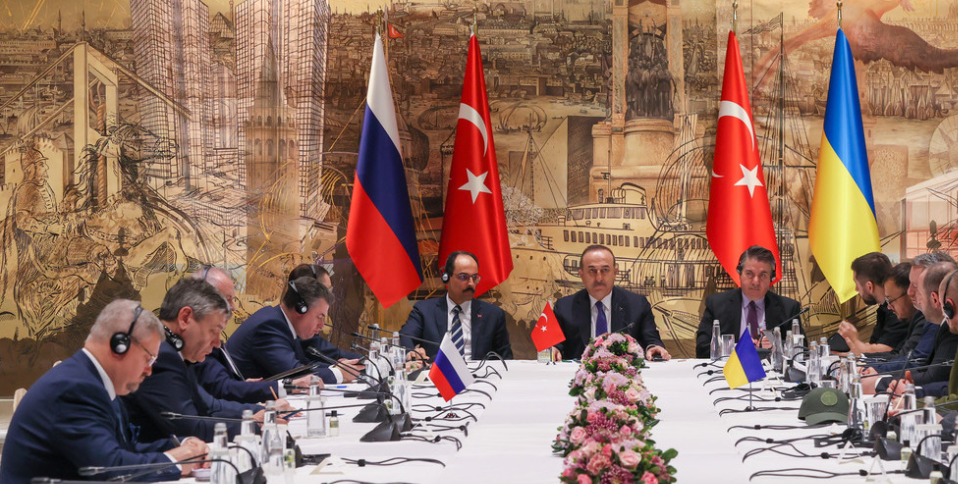
Six weeks into Moscow's military offensive, Russia and Ukraine do not have a mutually satisfactory agreement. A treaty between the two countries, when signed, could have far-reaching effects that go beyond bilateral relations, transforming the entire landscape of European security. On February 28, Moscow and Kiev kicked off the talks, focusing on four key areas: political aspects, demilitarization, the issue of Crimea and the Donbass, and the subject of NATO expansion.
So far the parties haven’t made much progress. The only breakthrough was made when Ukraine said it would be willing to abandon its NATO ambitions and to encapsulate this commitment in the country’s Constitution. This didn’t come about without conditions, however.
President Volodymyr Zelensky's government has stated that it will require the West to provide security guarantees. Here, RT looks at the implications of Ukraine committing to never joining NATO and remaining neutral. We will also discuss how the peace talks might reshape European security.
Talks, No Compromise
Whatever the outcome of Russia’s operation in Ukraine, it is bound to have a lasting impact on the geopolitical map of the world, and some changes are already apparent. The EU member states no longer see a way to go back to the status quo of the previous decade any time soon and are starting to reassess the risks of possible military conflicts on the continent. It seems like Western Europe can no longer simply remain a consumer of the security provided by the military support of the United States, as before.
After NATO effectively refused to accept Ukraine as a member, the Ukrainian government has realized that it won’t have back up in the case of disputes concerning its territory or sovereignty, whether now or in the foreseeable future. The long and arduous Russia-Ukraine talks in Istanbul helped make progress on this track: Zelensky said his country was willing to embrace a non-nuclear and non-bloc status.
In essence the deal is that Ukraine accepts, in return, binding security guarantees from the West, whereas the issue of Crimea and the Donbass becomes a matter for future discussion. The speaker of the Ukrainian Parliament Ruslan Stefanchuk already confirmed that Ukraine’s Constitution might be amended to remove the clause about Kiev's aspirations to join NATO, which is a prerequisite for any potential peace agreement with Russia.
“The thing is that integration with the EU and NATO is captured as a goal we pursue in the Constitution of Ukraine, which is a pretty high-level commitment. So we will keep following the progress of the negotiations and look for ways to have the agreements reflected in the Constitution either by expanding or amending it,” Stefanchuk said to TV channel Ukraine 24.
On more than one occasion since 2014, Russia has promised a decisive action if Ukraine continues to pursue its EU/NATO ambitions. As the military assault began, Moscow stepped up its demands. Ukraine is now not only to give up its membership prospects with NATO, but also with any other military bloc that may be formed in the future. Additionally, Ukraine will also have to opt out of producing or buying any offensive arms Russia might deem a risk to its security. “Ukraine must be demilitarized and denazified (…), these issues are pressing, because they pose a military, cultural, informational, linguistic and civilizational threat to Russia. It is a very clear threat, and it must be dealt with now,” said Russia’s Foreign Minister Sergey Lavrov.
At the same time, it is obvious the talks might lose momentum when it comes to working out the legal aspects of the deal and how it should be captured in Ukrainian law. Russia’s Foreign Ministry keeps reminding everyone that it’s determined to do everything in its power to ensure this deal doesn’t fall through like the Minsk Agreements. It all comes down now to one question: which steps Ukraine is ready to take and how it will affect its international standing.
A Long-Sought Dream
Back in 1991, when Ukraine claimed its independence, it positioned itself as a non-aligned state capable of protecting its sovereignty and territorial integrity. This principle was enshrined in its Declaration of State Sovereignty: “The Ukrainian Soviet Socialist Republic solemnly declares its intention to become a permanently neutral state that does not participate in military blocs and upholds three nuclear-free principles, i.e. never to accept, produce or purchase any nuclear weapons.” Ukraine’s Constitution adopted in 1996 contained a similar clause.
Everything changed after the 2004 "Orange Revolution," when the Western-backed Viktor Yushchenko beat the establishment candidate Viktor Yanukovich in a subsequent presidential election. Yushchenko began his term by announcing that Ukraine was going to work towards the goal of satisfying the requirements necessary to join both the EU and NATO. As early as in 2008, statements were made at the Bucharest Summit that NATO would welcome Kiev sometime in the future.
However, Ukraine did not denounce its non-alignment obligations until late 2014, when, in the wake of the Western-supported Maidan coup, Crimea was claimed by Russia and hostilities started in the Donbass area. Five years later, in 2019, President Petro Poroshenko signed a bill that proposed to enshrine Ukraine’s NATO aspirations in the country’s Constitution. At the same time, it is true that the nation remained officially non-aligned. Ukraine’s chances of joining NATO were quite weak because of its geopolitical standing and the turbulence in its domestic politics.
Nevertheless, after the US refused to discuss security guarantees with Russia, the Kremlin launched its special military operation and started to insist on Ukraine committing to a neutral and non-aligned legal status in a legally binding and internationally recognized way. It has to be noted that the current system of international law clearly differentiates between the terms “neutrality” and “non-alignment,” defining them as two fundamentally different types of legal status that entail obligations of different nature.
Non-alignment is self-determined by a state and isn't required to be enacted by international treaties. Although it involves non-participation in military alliances and blocs, the country retains the right to unilaterally reconsider its non-aligned status at any time. Besides, a non-aligned state can participate in armed conflicts, including those on foreign soil, and is free to enter into defense cooperation agreements with military alliances and individual states.
Neutrality, on the other hand, has to be defined by an international treaty and recognized by other subjects of international law. This status, in essence, implies that a state undertakes to implement the following: it can’t allow other countries to wage wars on its territory; participate in military operations abroad or discriminate against any of the warring parties in the way weapons, ammunition and other implements of warfare are supplied to them.
To ensure Ukraine becomes both neutral and non-aligned is going to be a very challenging task. On the one hand, neutrality is hardly even possible for the country, given the lack of geopolitical consensus on Ukraine’s future and its inability to protect its national interests on its own. This has to do with one of the indispensable attributes of neutrality, i.e. that it needs to be recognized by other subjects of international law. (In Europe, for example, only Switzerland has neutral status). On the other hand, being non-aligned (but not neutral) would in no way prevent Ukraine from pursuing active cooperation with NATO, which is something that Russia cannot accept.
It is possible that the plan to achieve compromise might include putting Ukraine on a fast-track to join the EU while it, in turn, would commit to never joining NATO. Indeed, historically, the question of NATO membership for Ukraine was raised in the context of the country seeking integration with Western Europe.
However concerns within the EU regarding Ukraine’s economic situation and state governance system meant joining the bloc wasn’t something that was likely to happen any time soon.
Joining NATO in this context was viewed by Ukraine’s European partners as a stage on its way towards EU membership, as this was something most other candidate states did before.
At the same time, joining NATO is no precondition for EU membership. Ireland and Austria are EU states that prefer to maintain their non-aligned status. Moreover, even though Serbia refused to join NATO, that was no obstacle on its path towards European integration. Therefore, it’s quite likely that Ukraine will be granted the coveted status of candidate state soon enough. Ukraine’s Deputy Prime Minister for European and Euro-Atlantic Integration Olga Stefanishina has already made statements in this regard. This way, Ukraine’s commitment to non-alignment, whether with NATO or any other military alliances or blocs, could become part of a larger deal focusing on Ukraine’s accession to the EU.
А New NATO
Nevertheless, the viability of this scenario is limited by the unresolved territorial disputes over the Donbass and Crimea. On the one hand, a big deal is hardly possible without Ukraine recognizing the independence of the Donetsk and Lugansk People’s Republics (DPR and LPR) within the borders of those regions, and renouncing its claims to Crimea. The Russian side is unlikely to give up any territory obtained during the current military operation in the Donbass. During a recent visit to Ukraine, even the EU’s High Representative for Foreign Affairs and Security Policy, Josep Borrell, said that the armed conflict “will be won on the battlefield.” On the other hand, there are big doubts that any Ukrainian government will agree to any loss of territory. So, we can just say that these issues will only be considered and resolved with the advent of peace. And this decision can be made without time limits.
The fact that such a scenario is possible is evidenced by the statements of the members of the Ukrainian delegation about the need to sign a comprehensive agreement on guarantees with respect to Ukraine’s sovereignty. This agreement, according to Ukraine’s position, should replace the Budapest Memorandum.
“An important part of these agreements is security guarantees. Security guarantees should presuppose the existence of a circle of States that will support our country. And in case of aggression by Russia against Ukraine, the leaders of these countries should help Ukraine in various ways,” Zelensky believes.
Kiev insists on guarantees that should be similar to Article 5 of the North Atlantic Collective Security Treaty. That is, if Ukraine becomes the object of military intervention, it will have the right to demand consultations within three days and, if these lead to nothing, then the guarantor countries should help with weapons and even close the skies.
Subscribe to:
Posts (Atom)